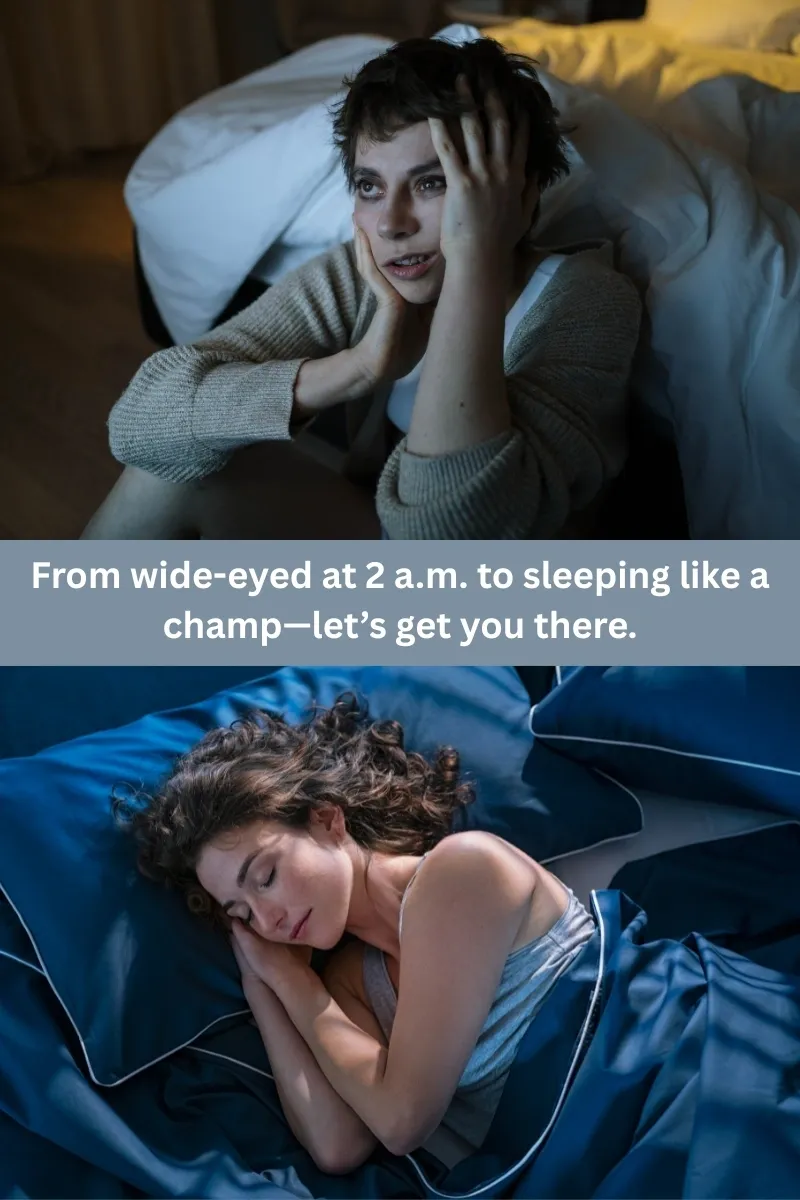
Struggling to Sleep in Midlife? Here’s What Really Helps
You lie in bed, exhausted… only to find your brain suddenly deciding it’s a great time to organize your entire mental junk drawer.
Or maybe you fall asleep quickly, only to wake up wide-eyed at 2 a.m., heart racing and mind spinning.
Or — the worst — you technically slept all night, but wake up feeling heavy, foggy, and unrested.
Sound familiar?
If this is hitting close to home, you don’t need more advice — you need a place to start. I’ve put together simple sleep routines and supportive habits you can actually try in my Sleep & Recovery section of The Mix — including sample routines and practical ideas to help you wind down, stay asleep, and wake up feeling more rested. If your mind tends to race at night, this is where your breathing can make a real difference — try these simple breathing exercises.
Welcome to midlife sleep —
where the old rules stop working.
Like so many other aspects of our lives, sleep is seriously impacted by the hormonal shifts, lifestyle changes, and internal chaos that show up in our 40s and 50s. This is one more situation where “doing what you’ve always done” just doesn’t cut it anymore. Your body is changing — and your habits, routines, and yes, sleep strategy, need to change with it.
How Sleep Changes in Midlife (And What’s Actually Causing It)
It feels sudden, right? One day you were out cold in five minutes, and now you’re negotiating with your pillow and Googling “natural sleep aids” at 3 a.m.
But it isn’t sudden — it’s layered. Midlife sleep disruption is the result of several things quietly stacking up over time.
Hormones like estrogen and progesterone (which help regulate temperature, mood, and sleep quality) begin to fluctuate and decline. As they shift, so do you — into a more restless, overheated, sometimes anxious version of your formerly well-rested self.
Add in heightened stress levels, increased cortisol production, and a nervous system that seems to go into overdrive after 9 p.m., and you’ve got the perfect storm for sleep sabotage. Even habits you once considered harmless — a glass of wine with dinner, your phone in bed, a late-night snack — now mess with your ability to fall or stay asleep.
Midlife doesn’t play by the old rules. And neither should your bedtime routine.
Why Quality Sleep Matters More Than Ever
Sleep isn’t just “rest.” It’s when your body and brain do their most important maintenance work.
While you sleep, your brain consolidates memories and clears out toxins (thank you, glymphatic system). Your muscles repair. Your immune system strengthens. Hormones that regulate everything from hunger to healing do their delicate balancing act behind the scenes.
When sleep quality dips, so does everything else: energy, metabolism, focus, even emotional regulation. Without good sleep, it can feel like you’re operating on a low battery — with a cracked screen.
How to Support Better Sleep in Midlife
Midlife sleep isn’t just a you problem — it’s a stage-of-life thing. And while there’s no one-size-fits-all fix, there are ways to stack the deck in your favor.
Here are a few sleep-supporting habits worth trying — and if you want a more complete set of routines and ideas to build from, you’ll find them all in my Sleep & Recovery section of The Mix.
- Cut back on alcohol, especially close to bedtime. Even one glass can disrupt deep sleep and trigger 2 a.m. wake-ups (trust me, my sleep score shows it).
- Avoid eating too late. Late-night snacks can spike your body temperature and metabolism, interfering with deep sleep.
- Dim the lights and power down screens at least 30 minutes before bed. Blue light delays melatonin production.
- Keep your bedroom cool — between 60–67°F is ideal.
- Stick to a sleep–wake schedule, even on weekends. Your body thrives on rhythm.
- Use blackout curtains or an eye mask to eliminate light and boost melatonin.
- Keep a notepad by your bed for late-night to-do list dumps and overactive thoughts. A brief journaling practice can help your mind settle so your body can rest.
- Try a simple breathwork practice before bed to calm your nervous system and lower cortisol. Even a few minutes can make it easier to fall asleep and stay asleep.
- Add a calming nighttime ritual, like a warm, unsweetened herbal or milk-based drink. Options such as peppermint or magnesium-supported drinks can help cue your nervous system that it’s time to wind down.
A few small shifts can add up to a big difference — even if you’re not aiming for “perfect sleep,” you can at least stop losing the battle night after night.
Of all these habits, routine matters most — and morning sunlight is the simplest way to support it.
Morning Sunlight and Circadian Rhythm: A Key to Better Sleep
Here’s the part most of us miss: good sleep doesn’t start at bedtime — it starts when you wake up.
Morning sunlight plays a powerful role in setting your internal clock — also known as your circadian rhythm. When natural light hits your eyes early in the day, it signals your brain to stop producing melatonin and start the daytime hormone cycle.
That same signal tells your body when to release melatonin later that night. In other words, morning light helps your brain know when it’s time to sleep — hours before your head ever hits the pillow.
In midlife, this signal becomes even more important. Hormonal shifts make sleep timing more sensitive, which is why a few minutes of natural morning light can help reduce trouble falling asleep and those frustrating 2–3 a.m. wakeups.
I share more about how I use morning light as part of my own routine — and why it’s one of the simplest midlife sleep supports — in Morning Sunlight: The Midlife Hormone Reset Your Body Needs.
Technology That Supports Sleep in Midlife
Still need some backup for better sleep? Good news: there’s plenty of tech out there designed to help you catch those elusive Zzz’s.
One of my favorite tools in my midlife Tool Kit is the Oura Ring.
It’s a sleek little wearable (yes, a ring — not some giant wrist spaceship) that tracks your heart rate, body temperature, breathing, and movement throughout the night. All of that data combines into a daily Sleep Score that tells you how well you actually rested.
It’s honestly become a fun little competition in our house. My husband and I now start the day comparing our scores to see who “out-slept” the other. Spoiler: he usually wins when I stay up too late scrolling memes or mentally rewriting awkward texts from 2009.
The best part? I can actually see how certain habits affect my sleep. That glass of wine? My score drops. Eat too close to bedtime? Same story. And interestingly, when I skip dinner as part of intermittent fasting, my sleep score is often the highest — clear proof (at least for me) that eating late can make an impact.
And it’s not just about the tracking. Oura also offers built-in meditation and breathwork sessions you can use anytime — day or night — to bring down cortisol and help your body ease into rest mode.
Other Sleep-Supporting Apps and Gadgets Worth Exploring Include:
- Calm and Headspace: Known for their guided meditations, sleep stories, and calming soundscapes.
- Insight Timer: A free app packed with thousands of meditations and sleep aids.
- Sleep Cycle: Tracks your sleep phases and gently wakes you up at the ideal time.
- White noise machines or smart speakers (like Alexa or Google Home): Helpful for creating a consistent, soothing sound environment.
These tools can be helpful, but they work best when layered into supportive sleep habits you can actually stick with.
Next Steps
Everyone’s body is different — so it’s worth experimenting to find what helps you wind down best.
If you’re looking for extra support, I’ve curated a Midlife Tool Kit with sleep tools I actually use and trust — along with a few calming practices and nighttime rituals I share in The Mix to support rest and nervous system balance.
You don’t need to fix everything — just start with one small shift.
And if you’ve tried some of these approaches but your sleep still feels inconsistent, it may be a sign that your body needs a different strategy in this stage of life.
I take a closer look at what’s actually changing — and what tends to work better in midlife — here: Why Midlife Sleep Requires a New Strategy
If you found this helpful, you can subscribe to be notified when new blogs or resources are added.