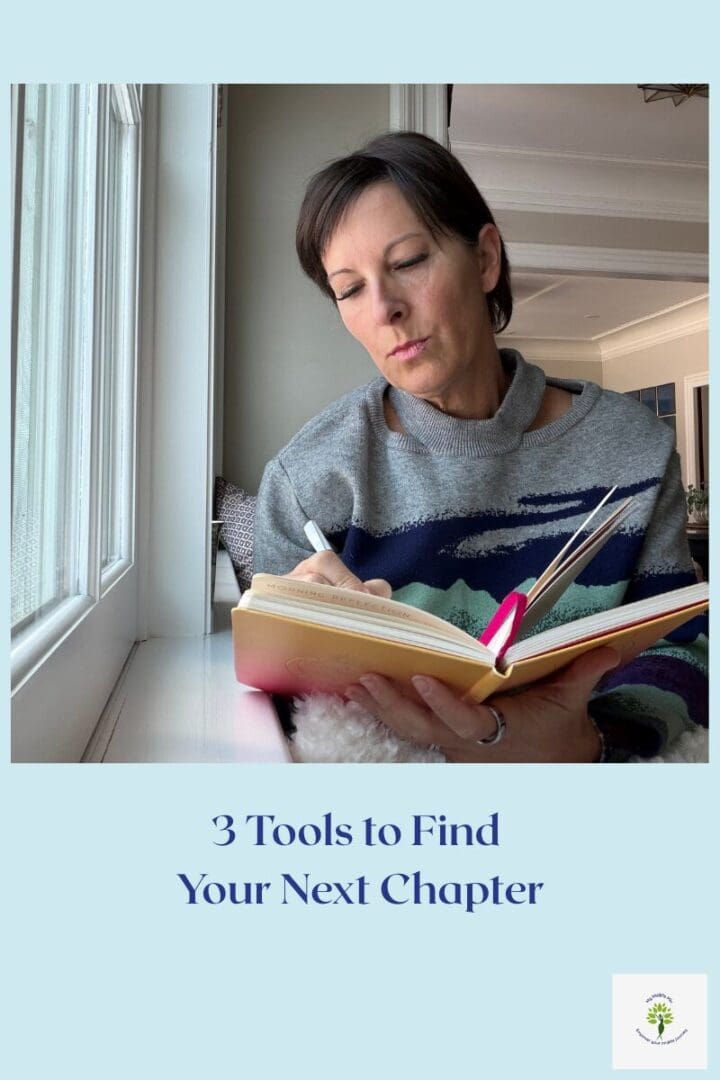
How to Find Direction in Midlife: Tools to Reassess Your Goals
If midlife has you feeling directionless,
you’re not alone.
More importantly—you don’t need more overthinking. You need a place to start. Below are 3 simple tools to help you start finding direction again. (You can scroll down to jump right to them.)
Recently I’ve been talking with several women who are navigating different kinds of transitions and turning points in midlife. The mix of curiosity, uncertainty, and quiet questioning about what comes next is very real.
Moments like this are often when women begin searching for direction in midlife — especially as the roles, routines, and priorities that once felt steady start to shift.
For some, it’s children growing up and becoming more independent. For others, it’s changes in career, relationships, health, or simply a growing awareness that something feels ready to evolve.
On the outside, everything may still appear to be moving along just fine. But internally, many women begin asking a quieter question:
What does the next chapter of my life look like?
You don’t need a full reinvention—just a way to step back and get clear on what matters now.
Three Simple Tools to Help You Find Direction
Journaling — to clarify your thoughts
Vision boards — to visualize what’s next
Life mapping — to step back and see the bigger picture
I’ll walk you through how to use each one — with simple prompts and questions to help you start gaining clarity right away.
Journaling: How to Get Clear on What You Actually Want
Of course I have to start with one of my favorite tools — the journal.
I’ve written an entire blog dedicated to the many types and purposes of journaling because it can be such a powerful tool for reflection, clarity, and personal growth. If you want to go deeper, I break that down in my post on the benefits of journaling in midlife.
But this isn’t about daily gratitude lists or recording events from your day.
This kind of journaling is about exploring where you are in life right now and what might be calling you forward next.
When our thoughts stay in our heads, they tend to swirl together and feel overwhelming. Writing them down gives us a chance to see our ideas and true feelings more clearly.
A good place to begin is by asking yourself a few open-ended questions and allowing your answers to unfold naturally on the page. For example:
- Where am I in life right now?
- What parts of my life feel fulfilling?
- What parts feel draining or out of alignment?
- What interests or curiosities keep resurfacing for me?
- What might I want more of in the next decade of my life?
- What small steps or changes can help set me in a new direction?
There are no right or wrong answers here, and there is no need to force clarity too quickly.
Sometimes journaling helps us notice patterns — the ideas, values, or interests that appear again and again when we give ourselves space to think.
It can also help turn vague hopes into something more tangible. When you begin writing down even small possible steps — learning something new, exploring a long-held interest, reconnecting with something you once enjoyed — those ideas start to feel more realistic and less intimidating.
That process of reflection is where new direction begins.
You don’t need to have all the answers yet.
The goal is to start asking better questions.
Vision Boards: A Simple Way to Visualize What You Want Next
While some people process their thoughts best through writing, others connect more strongly with images and visual inspiration. A vision board is simply a collection of images, symbols, words, or phrases that represent what you hope to bring more of into your life. The goal isn’t artistic perfection — it’s choosing visuals that spark a genuine emotional reaction when you look at them.
Sometimes images reveal desires or interests that haven’t fully surfaced yet.
For example, as you flip through magazines or search for images, you may find yourself repeatedly drawn to themes related to:
- travel or adventure
- creativity or learning
- health and vitality
- peaceful environments
- community or connection
These patterns can offer quiet clues about what feels meaningful to you right now.
While digital vision boards are easy to create, I find a physical board more grounding and reflective. Cutting out images, arranging them, and placing the board somewhere visible allows you to revisit those ideas regularly without having to open a screen.
Some people like to organize their board into categories such as health, relationships, career, or personal growth. Others simply allow the images to gather organically without worrying too much about structure.
There’s no wrong approach.
The purpose of a vision board isn’t to create a rigid plan for the future. Instead, it helps you begin noticing what inspires you, what energizes you, and what kinds of experiences you might want more of in the years ahead.
Over time, the images you’ve chosen can act as gentle reminders of the direction you want to explore.
If you’d like a deeper look at how vision boards work and why they can be effective, this article from Intelligent Change offers a helpful overview.
Life Mapping: How to See the Bigger Picture of Your Life
While journaling and vision boards can help uncover thoughts, interests, and possibilities, some people want to take things one step further and organize those insights into a more structured picture.
This is where life mapping comes in.
A life map is a way to orient yourself — connecting where you are now with what matters to you and what direction you want to explore.
It allows you to step back and look at your experiences, skills, interests, and values in a more connected way. When these pieces are laid out, it becomes easier to see patterns, possibilities, and small next steps that might otherwise remain hidden.
I was first introduced to life mapping during a stay at a health resort, and I was struck by how simple — yet powerful — the exercise was. With nothing more than a piece of paper and a little time for reflection, it offered a way to step back and ask a bigger question:
How might my life begin to reflect the person I’m becoming?
Life mapping is simpler than it sounds — it’s about stepping back and seeing how the different areas of your life connect.
Let’s walk through the steps to create a life map and find your direction.
Step 1: Where Am I Right Now?
The first step in life mapping is taking an honest look at where you are today without judgment.
Midlife can be complicated because several roles or life stages may overlap at the same time. Some responsibilities may be winding down while others are just beginning. Writing these things down helps create a clear starting point.
Going through this exercise myself, my list looked something like this:
• Empty nester
• Stay-at-home mom
• Volunteer
• Former teacher
• “CEO” of our household
• Overseeing the building of our retirement home
Seeing these written out helped me recognize something important: even though some roles were changing, my life was still filled with meaningful experiences and skills.
For readers trying this exercise, you might ask yourself:
• What roles define my life right now?
• What responsibilities fill most of my time?
• What transitions am I currently experiencing?
Sometimes acknowledging where you stand today brings surprising clarity.
You don’t begin with where you want to go.
You begin by understanding where you are today.
Step 2: What Has Shaped Me?
Next, take a step back and consider the experiences and skills that have shaped who you are today.
Many midlife women underestimate how much knowledge and resilience they’ve built over the years — especially when much of that experience happened outside of traditional career paths.
When I reflected on this step, several themes stood out.
My background in teaching reminded me how much I enjoy helping others understand ideas. Teaching required creativity — finding ways to make information engaging and approachable.
But creativity wasn’t limited to the classroom. It showed up in many parts of my life — planning projects with my kids, organizing activities, and even entertaining friends and family. I enjoyed creating welcoming spaces and thinking through the details that helped people feel comfortable and connected.
Managing a household and raising a family also strengthened my ability to organize systems, plan ahead, and juggle responsibilities.
Seeing these patterns helped me recognize something important:
I wasn’t starting from scratch. I was building from decades of experience.
You might ask yourself:
• What skills have I used throughout my life?
• What roles have come naturally to me?
• What interests or talents have followed me through different stages?
Often the clues about what comes next are hidden inside the things we’ve been doing all along.
Step 3: What Matters to Me Now?
After reflecting on the past, the next step is to consider what feels meaningful at this stage of life.
Midlife often brings a shift in priorities. The things that once felt urgent may begin to change, and new interests may start to emerge.
When I went through this step, several themes surfaced for me.
Health and wellness had become increasingly important as I began navigating some of the changes that come with perimenopause. That sparked a deeper interest in learning how lifestyle choices can support long-term health.
I also realized how much I enjoyed learning and sharing information. Writing had become something I genuinely looked forward to, and I felt curious about developing new skills connected to that interest.
You might ask yourself:
• What topics or activities energize me now?
• What do I find myself wanting to learn more about?
• What do I want more of in my daily life moving forward?
These answers often provide powerful clues about where your curiosity may be leading.
Step 4: Asking the Question of Purpose
After reflecting on where you are, what has shaped you, and what matters to you now, a natural question often emerges:
What might purpose look like in this stage of life?
That question doesn’t need an immediate answer.
In midlife, purpose often begins as curiosity rather than certainty.
When I reached this step, I realized that many of my past roles had focused on supporting others — supporting my children and husband, running our household, and helping oversee the building of our retirement home.
All of those roles were meaningful. But this exercise prompted a new question:
What might purpose look like for me personally moving forward?
Readers exploring this step might ask:
• How might I use my experiences to help others?
• What kinds of contributions would feel meaningful now?
• What activities give me a sense of fulfillment?
Purpose doesn’t always appear as a clear destination. Often it begins with a question.
Step 5: Brainstorm and Visualize Possibilities
Once you’ve reflected on these questions, the next step is to explore ideas.
This stage is intentionally open and creative. The goal isn’t to make decisions yet — it’s to notice possibilities.
When I did this exercise, several interests began to surface:
• A growing interest in midlife health and wellness
• A desire to keep learning new skills
• A love of writing and sharing information
• Curiosity about how lifestyle habits impact long-term health
• A desire to support other women navigating this stage of life
At the time, these weren’t a plan — they were simply threads worth exploring.
You might ask yourself:
• What topics do I naturally enjoy learning about?
• What activities make me lose track of time?
• What interests have been quietly resurfacing?
This step is about exploration, not commitment.
Step 6: Try Small Experiments
One of the most helpful realizations in midlife is that you don’t need a perfect plan before you begin.
Direction often becomes clearer after trying a few small things.
Instead of waiting for certainty, life mapping encourages small experiments — exploring an interest without completely changing your life.
Looking back, that’s exactly how My Midlife Mix began.
I didn’t set out to build a website or start a blog. I simply followed a thread of curiosity about midlife health and wellness.
From there, I started experimenting:
• learning how websites work
• exploring blog-style writing
• creating graphics in Canva
• sharing ideas that might help other women
Each step was small, but over time those steps connected and eventually grew into My Midlife Mix.
Sometimes the next chapter doesn’t reveal itself all at once. It grows gradually from curiosity, experimentation, and a willingness to try something new. I will also say a little encouragement from family and friends who know my interests was helpful too.
Midlife often brings questions about direction, purpose, and what the next stage of life might look like. If you find yourself reflecting on these ideas, you’re far from alone.
Tools like journaling, vision boards, and life mapping don’t provide instant answers — but they do create space to pause, reflect, and begin noticing what matters most to you now.
Sometimes the next chapter begins with something small: a new curiosity, a conversation, or an idea worth exploring.
If you’d like additional prompts and reflection tools, you can find journaling exercises and related resources in The Mix here on My Midlife Mix.
And if uncertainty or mental overwhelm is part of what you’re navigating during this stage of life, you may also find my article on calming the midlife nervous system helpful.
If you’d like to stay connected, consider subscribing so you’ll be notified when new blog posts, tools, and resources are added to the site.