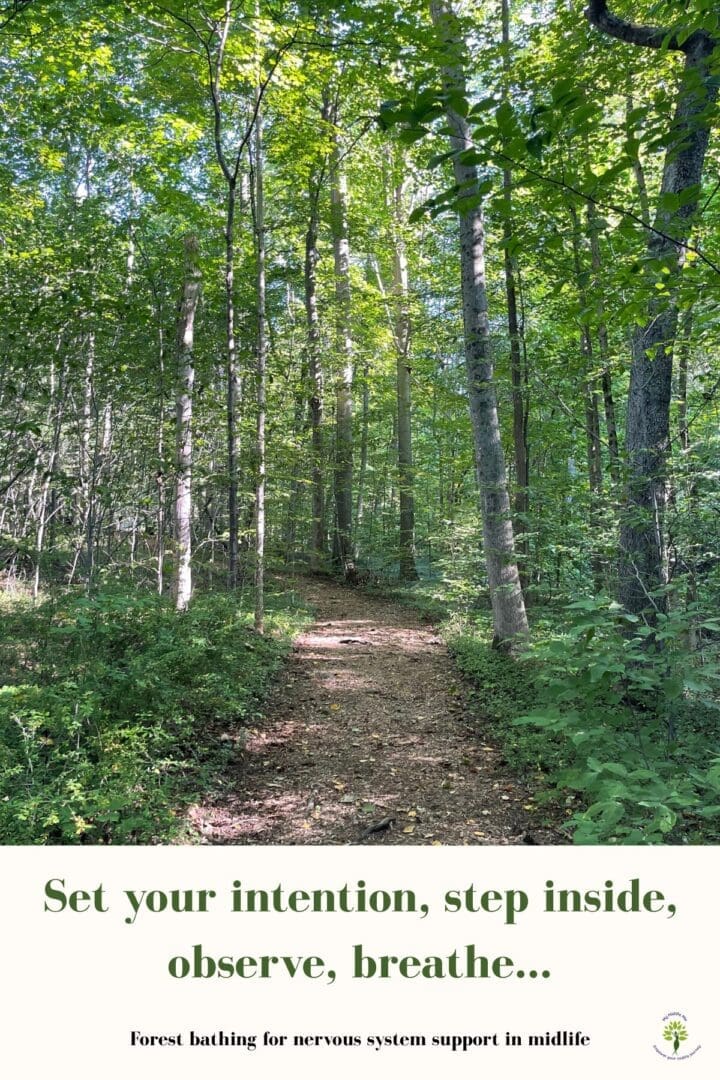
How Nature Helps Calm Your Midlife Nervous System
If you’ve been feeling more anxious, wired, or just not quite like yourself lately, your nervous system may be overstimulated.
And in midlife, that happens more easily than most of us expect.
The good news is that there are two simple, free ways to calm your nervous system naturally—both found right outside your door.
Forest bathing and grounding.
You may have heard of them—but how do you actually use them in real life?
I’ll walk you through each one, with simple ways to get started right away.
Forest Bathing: A Natural Way to Calm Your Nervous System
You don’t need a dense forest to benefit from this—but you do need to be around trees.
A tree-lined street, a quiet park, or even your backyard can work.
The goal isn’t location—it’s giving your body enough exposure to nature to begin responding.
Start here — a simple way to try it:
At first, this can feel a little unnatural—especially if you’re used to moving quickly or always having a purpose.
Step outside and slow down.
Instead of walking for distance or exercise, walk without a goal. Pause. Look around. Take in the natural surroundings.
Breathe in deeply through your nose.
Use your senses:
Look at the colors (especially greens)
Listen to the sounds around you
Feel the textures—tree bark, leaves, the ground beneath your feet
Smell the scents in the air
Notice the air moving across your skin or moving the leaves and branches
Giving yourself 10–15 minutes is enough time to start feeling a shift. Within that time, your breathing slows and your mind begins to quiet—subtle, but noticeable.
What this actually is (and what it’s not)
Forest bathing isn’t hiking or exercising.
It’s a slow, mindful immersion in nature—where the goal isn’t to “do,” but to notice.
You’re not trying to get somewhere.
You’re letting your body settle by being present in your surroundings.
Why this works
When you spend time in nature this way, your body begins to shift out of a stressed state. This is why even a short walk outside can feel different than time spent indoors.
It’s not just a break—it’s your body responding to a different environment.
Research shows it can:
- Lower cortisol (your stress hormone)
- Reduce blood pressure and heart rate
- Support immune function
- Help reduce Inflammation
- Activate your parasympathetic nervous system (your “calm” state)
Simply put—your body starts to feel safe again.
You don’t need to understand all the science for this to work—but it’s reassuring to know it’s there. Research on forest environments (often called Shinrin-yoku) has shown measurable effects on stress, cardiovascular health, and immune function.
What’s happening behind the scenes
Trees release natural compounds called phytoncides to protect themselves.
When you breathe them in, your body responds by:
- Reducing inflammation
- Lowering stress hormones
- Supporting overall nervous system balance
But it’s not just the chemical response that makes this powerful.
The act of slowing down, engaging your senses, and stepping out of constant stimulation plays an equally important role. This is the same principle behind mindfulness—learning to bring your attention back to the present moment in a way that helps calm your nervous system.
Together, these elements—both chemical and sensory—are what create the overall effect.
This practice originated in Japan and is still used there today as a form of preventive health.
A simple way to think about it
You’re not just “getting fresh air.”
You’re giving your nervous system a break from constant input—and allowing it to reset naturally.
If you’ve tried breath work before, this often creates a similar calming effect—just in a more natural, effortless way.
My Shinrin Yoku Experience
The first time I tried forest bathing was with a guide, and I didn’t know what to expect.
We began with a simple pause—setting an intention before stepping into the forest.
Then we walked slowly, without a destination. No talking, no rushing. Just noticing.
The light filtering through the trees. The sound of leaves shifting. The texture of the ground beneath our feet.
At the end, there was a quiet moment of acknowledgment—thanking the forest before stepping back out.
It wasn’t complicated, but it changed how I approached being outside.
Even now, I carry a small version of that with me—pausing before I start, slowing down while I’m there, and noticing how I feel when I leave.
Grounding (Earthing): How Direct Contact with the Earth Calms Your Nervous System
If you haven’t done this before, it might feel almost too simple to matter.
But this is one of those practices where the simplicity is the point.
Start here — a simple way to try it:
You’re giving your body something it rarely gets anymore—direct contact with the Earth.
Step outside and make direct contact:
- Walk barefoot on grass, sand, or soil
- Sit or lie down on the ground
- Place your hands on natural surfaces
Give yourself 10–20 minutes and notice how your body feels. For many people, it shows up as a quiet sense of calm or a feeling of being more settled.
You don’t need anything fancy
An exotic beach or remote location isn’t necessary.
A backyard, local park, or any outdoor space where you can touch natural ground works.
Grounding is simply direct physical contact with the Earth’s surface, including:
- Soil
- Grass
- Sand
- Water
- Natural stone
Softer, more conductive surfaces like soil, grass, and sand tend to have the strongest effect.
Rock can still work—especially if it’s slightly damp—but it’s generally less conductive.
Why this works
When your body makes contact with the Earth, it helps bring your system back into balance.
Research suggests grounding may:
- Reduce stress and inflammation
- Support better sleep
- Calm the nervous system
- Support circulation and overall cardiovascular health
Many people notice they simply feel more settled and clear afterward.
You don’t need to understand all the science for this to work—but it’s helpful to know there’s a reason behind what you’re feeling. Research on grounding (also called “earthing”) suggests it may help reduce inflammation, support immune function, and aid in recovery.
What’s happening behind the scenes (if you’re curious)
The Earth carries a natural electrical charge.
When your skin touches it, your body may absorb free electrons that help neutralize oxidative stress (inflammation).
You don’t need to overthink this part—the effect matters more than the mechanism.
Can You Calm Your Nervous System Indoors? (Grounding Mats Explained)
If you can’t get outside regularly, there are ways to simulate grounding indoors.
Grounding mats are designed to mimic contact with the Earth by creating a similar electrical connection. Some versions also incorporate heat or layered materials that generate negative ions—similar to what’s found naturally outdoors.
They’re often used while:
- Sitting at a desk
- Sleeping
- Relaxing at home
I’ve used a higher-end version, especially during times when getting outside regularly wasn’t realistic.
While nothing replaces being outside, I’ve found it can help take the edge off—especially when used consistently.
They’re not essential, but they can be a helpful support when life gets busy. This is something I may include in my Tool Kit if I continue to see benefits.
In a world that’s constantly pulling your attention outward, your midlife body is asking for something different—a chance to slow down and reset.
These practices aren’t new. But they matter more now than ever.
We’re overstimulated, and in midlife, shifting hormones can make us even more sensitive to that constant input. What once felt manageable can start to feel like too much.
This is your reminder to step back and take care of yourself in a way that actually supports your body.
Forest bathing and grounding are simple, accessible, and backed by growing research. You don’t need to overhaul your life—just start small.
Try one this week. Your body will let you know it’s working.
Next Steps
If this resonated, here’s where to go next:
If your nervous system has been feeling constantly “on,” begin with
Why Your Nervous System Feels Overwhelmed in Midlife — and What Helps
It will help you understand what’s happening in your body—and what to try.
Want something you can do today?
Try these simple techniques:
Breathing Exercises for Midlife Women to Reduce Stress, Improve Sleep, and Boost Energy.
Prefer quick, go-to ideas?
Visit The Mix — a collection of simple tools, routines, and resets you can come back to anytime.
If you’d like to be notified when new tools and ideas are added, you can join the My Midlife Mix community. No spam, no selling — just thoughtful support for midlife.
Small steps, big shifts.