
10 Fitness Markers Every Midlife Woman Should Track for Strength and Longevity
At some point in midlife, most of us start thinking more intentionally about our health — but knowing where to start isn’t always clear.
You might feel a little less steady, a little less strong, or like your energy isn’t quite where it used to be. But vague goals like “get back in shape” don’t give you anything concrete to work from.
What actually moves the needle is knowing where you stand — and having a way to measure it.
Because in midlife, fitness isn’t about how things look. It’s about supporting strength, balance, mobility, and stamina— the things that carry you through daily life and help protect long-term health.
That’s where these fitness markers come in. They give you a clear starting point — and a way to track real progress over time.
Try a few of these tests over the next couple of weeks and record your results. This gives you a real starting point — and a clearer sense of where to focus.
If you’re not sure what to do with that information, I’ve put together a follow-up guide on how to improve your fitness markers in midlife, where I walk through how to build strength, balance, mobility, and stamina once you know your baseline.
You can also download the Fitness Marker Tracker to record your results and revisit them over time — it’s available in the post and in the Tool Kit under Track & Transform.
Your Midlife Fitness Baseline: 10 Tests to Try Today
Now that you understand why a true starting point matters, here are the 10 simple tests that can show you exactly where your midlife fitness stands.
✦ Grip Strength:
Grip strength is one of the strongest predictors of longevity and overall health (article linked here). It’s linked to better muscle mass, improved metabolic health, lower inflammation, and reduced cardiovascular risk. A hand dynamometer is the gold standard for measuring it, but you can also gauge progress with simple functional tests.
For an easy at-home check, try a dead hang from a bar. If you’re new to hanging, start with 10–20 seconds and build up gradually. Aim for 30, then 45–60 seconds, with 90 seconds as a strong long-term goal. The most important marker isn’t a specific number — it’s steady improvement over time.
✦ Farmer’s Carry:
A farmer’s carry is one of the most functional strength tests you can do. It measures your ability to stabilize your core, maintain healthy posture, and generate the strength needed for everyday life. To perform it, hold weight in both hands and walk with steady, controlled steps.
A good long-term goal is to carry half to three-quarters of your body weight (split between both hands) for 30–60 seconds. This test reflects the real-world strength we rely on daily and is strongly tied to long-term independence. Start light, focus on control, and build up gradually toward these targets.
✦ Balance and Stability:
Balance often declines earlier than most women expect — sometimes even in our 40s — and it plays a major role in brain health, fall prevention, and long-term mobility. A simple test is standing on one leg. If you can hold your balance for 30–45 seconds on each side with your eyes open, you’re in a strong place.
For a deeper look at your nervous system’s stability and coordination, try holding the same one-leg stance with your eyes closed, even if just for a few seconds. You can also add a functional challenge by standing on one leg while putting on and tying a shoe, which mimics real-life coordination and control.
✦ Push-Up Strength:
Push-ups are one of the most complete measures of upper-body and core strength. They tell you a lot about your chest, shoulders, arms, and deep core engagement — all areas that naturally decline in midlife if we’re not actively supporting them.
According to Mayo Clinic fitness benchmarks, women in their 40s and 50s typically fall in the range of 10–14 push-ups for good strength, with 10 push-ups being average at age 55. So if you’re able to perform 7–10 full push-ups, you’re already in a strong place. Reaching 10–20 push-ups shows excellent upper-body health for midlife and beyond.
If full push-ups aren’t accessible yet, incline push-ups or wall push-ups are perfect alternatives. Start higher, focus on form, and gradually lower the incline over time — you’ll build strength you can truly feel.
✦ One-Mile Walk Test:
How fast you can walk a mile is one of the simplest indicators of your cardiovascular health. It reflects your stamina, heart strength, and how efficiently your body uses oxygen — all essential measures for midlife wellness.
For women in midlife, completing a brisk mile in 13–15 minutes is a solid benchmark. Finishing in under 13 minutes places you in an excellent cardiovascular range. Think of this test less as a race and more as a fitness snapshot — a quick way to see how your heart and lungs are supporting you right now.
✦ Sit-to-Stand Strength:
One of the most accessible lower-body strength tests is the sit-to-stand (chair stand) — especially useful for midlife women because it reflects how well your hips, legs, and joints support everyday movement. The widely used 30-Second Chair Stand Test has been validated as a reliable indicator of lower-body strength and functional capacity in adults.
A good benchmark (often used in older-adult studies) is about 12–15 full stands in 30 seconds— but more important than the number is steady improvement over time, especially if you’re building strength from a lower base.
If you’re younger or just starting out, use it as a baseline test: record your reps, then re-check in 6–8 weeks to track progress.
✦ Single-Leg Sit-to-Stand (Advanced Strength):
If you’re looking for an advanced benchmark, try standing up from a chair on one leg without using your hands. Being able to perform 4–6 controlled repetitions per leg shows strong single-leg strength, hip stability, and balance, while 7 or more indicates excellent lower-body capability. This test reveals how stable and coordinated each leg is on its own — a key marker for long-term mobility and independence.
✦ Floor-to-Stand Mobility:
Another valuable test is how easily you can get up from the floor. Sit cross-legged and try to stand without using your hands — or with as few points of contact as possible. This simple movement combines balance, flexibility, coordination, and lower-body strength, making it a powerful indicator of functional fitness in midlife.
Higher scores on this test have been linked to better longevity and overall mobility, according to research highlighted by Harvard Health. (Read the Harvard Health article about the “sit-rise” test and longevity.)
✦ Core Endurance (Plank Test)
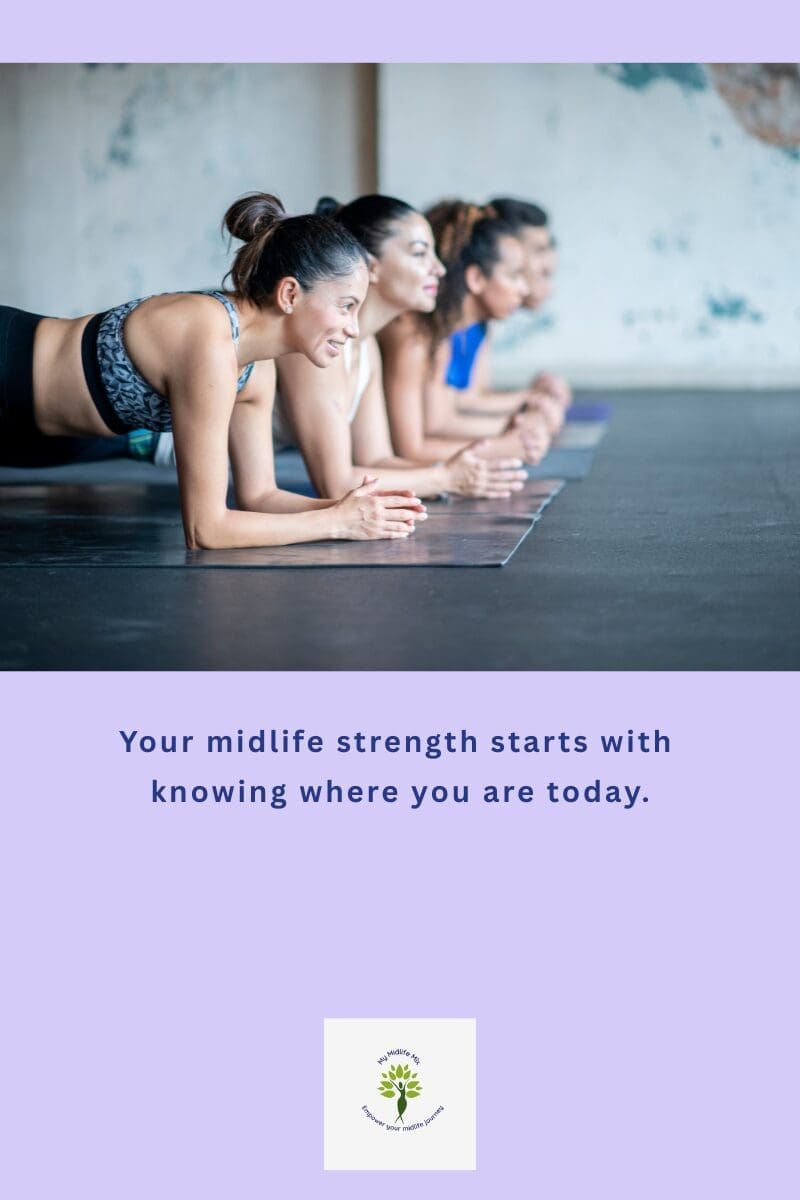
A strong core is essential for stability, posture, and back health — especially in midlife. To test your core endurance, hold a plank on your elbows, either from your toes or your knees. Being able to maintain good form for 45–60 secondsshows solid strength and control.
If you’re a beginner, start with 10–15 seconds and build up gradually. Once you can hold a steady plank for a full minute, you can add challenge with small movements — such as lifting a leg, tapping a hand to the opposite shoulder, or sliding a light weight from side to side — all while keeping your body stable. The goal isn’t perfection; it’s developing enough core strength to support your body in daily life.
✦ Your VO₂ Max Trend:
You don’t need a lab test for this one. Most devices — like an Apple Watch, Garmin, or Oura Ring — estimate your VO₂ max, which is one of the strongest predictors of long-term cardiovascular health and longevity. Instead of aiming for a perfect number, look for your VO₂ max to stay within a healthy range for your age or trend upward slowly over time. Even small improvements are linked to better stamina and lower risk of chronic disease.
What is VO₂ max?
VO₂ max measures how well your body uses oxygen during exercise — essentially how strong and efficient your heart and lungs are. A higher VO₂ max usually means better cardiovascular fitness, greater endurance, and stronger long-term health.
A validated field test used by YMCA and many clinical programs.
How it works:
- Step up and down an 12-inch step for 3 minutes at a steady pace
- Sit down and immediately measure your heart rate for 60 seconds
- Lower heart rate = better aerobic fitness
There are free charts online (YMCA Step Test Norms) that categorize results by age and sex.
means better stamina, better cardio health, and a lower risk of chronic disease.)
Your Next Step
Now that you’ve worked through all ten tests, remember this is a snapshot of where you are today. Tracking your baseline gives you a clear starting point — and a practical way to shape your fitness going forward.
You don’t need to tackle everything at once — start with one area and build from there.
If you’re not sure what to do next, I walk through exactly how to prioritize and improve your fitness markers over time in this follow-up guide — including how to build strength, balance, mobility, and stamina once you know your starting point.
Read next: How to Improve Your Midlife Fitness Markers
If you want to keep building from here, these resources support steady progress:
- Strength training in midlife — why it matters and where to begin
- Daily movement markers (The Mix — Fitness tab) — 10-minute strength routines to come back to anytime
- Recovery tools (Tool Kit) — support recovery, sleep, and long-term consistency
If this guide was helpful, you can subscribe to be notified when new blogs or resources are added.
Here’s to midlife strength — because “fine” is not the vibe.

Linda @ My Midlife Mix